History
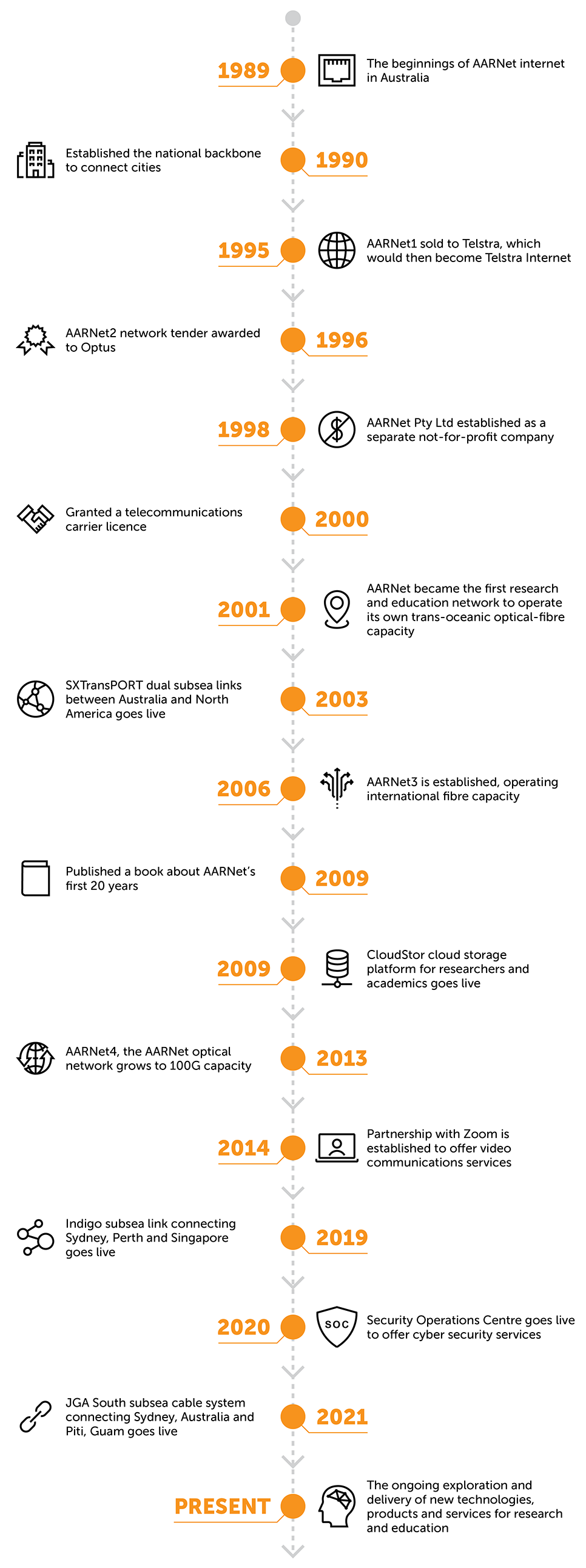
1989
The Australian Universities and the CSIRO, under the
umbrella of the Australian Vice-Chancellors' Committee (AVCC),
initiated a project called the Australian Academic and Research Network
(AARNet) - this was the genesis of the Internet in Australia.
During the first few years Australian Internet traffic was
predominantly to the founding members, (99%). A small amount of
commercial traffic was mainly from organisations that had a close
association with the tertiary and research sector. However, in addition
to providing support for the teaching, learning and research activities
of universities and research organisations, AARNet positioned itself as
a wholesale backbone Internet Service Provider (ISP). This encouraged
smaller ISPs to emerge without the requirement for extensive capital
investment in international and domestic infrastructure. This strategy
allowed the ISP to grow from 2 commercial ISPs in 1992 to over 300 by
June 1995. The total use by the non-AARNet user base had increased to
~20% of total traffic by that time.
1995
The commercial customer base of AARNet was sold to
Telstra, spawning what was subsequently to become Telstra BigPond. This
stimulated further growth of the commercial and private use of the
Internet in Australia. The intellectual property and expertise transfer
to industry resulted in development of the Internet in Australia that
would not have otherwise occurred at such a rapid rate.
1997The AVCC developed AARNet2, a further refinement of
the Internet in Australia, which employs high bandwidth ATM links and
Internet services under a contract with Cable & Wireless Optus
(CWO) - now Optus. The rapid deployment of IP services by Optus to meet
the AARNet2 requirements was due in part to the transfer of knowledge
and expertise from AARNet.
1998
APL was incorporated on 22 December 1998 with the sole shareholder
being the Australian Vice-Chancellors' Committee (AVCC). The company
became fully operational in March 2000 after completing the transfer of
functions from the AVCC. APL is a not-for-profit company limited by
shares. The shareholders are 38 Australian Universities and the CSIRO.
2001
AARNet deployed its first international capacity by
acquiring 310 Mbps of capacity from Sydney via Hawaii to Seattle. This
provides access to the advanced research and education networks of many
countries including North America, Europe, Japan, Taiwan, Asia and
South America.
2002
AARNet was the prime motivator in implementing GrangeNet
which provides a high capacity research network of 5 Gbps from Brisbane
to Sydney and 10 Gbps between Sydney, Canberra and Melbourne. AARNet has also worked with local Regional Network Organisations to achieve high capacity metropolitan and regional networks.
2006
Having aquired NextGen fibre, AARNet builds a leading edge high speed network. AARNet3 is officially launched at Parliament House, Canberra on the 14th September 2006.